Financial sector in India is mainly comprised of banking organisations with commercial banks accounting for more than 64% of the total assets held by the financial system. In India the banking sector largely influences the growth of financial markets. Since the growth in financial sector and the overall economic growth are highly interdependent, the health of the banking sector is critical to the health of the larger economy.
Infrastructural growth has been an important factor that supports economic growth, therefore banks have always concentrated on increasing their infrastructure financing portfolio through lending and investments. But since the collapse of IL&FS( a major infrastructural lenders) in 2018, the NBFCs (Non banking financial companies) and housing companies which act as the country’s shadow banking sector have been struggling. The scam at Punjab and Maharashtra Co-operative (PMC) bank discovered in 2019, that led to a loss of at least 43.55 Billion rupees ( $610 million ) has further exposed the serious corporate governance problems prevailing in this sector. And all these problems pose serious threats to the banks, since they are the primary lenders and investor for the NBFCs and HFCs.
Even the reserve bank of India, in it’s financial stability report (FSR), has recommended the public sector banks to build strong buffers to absorb any disproportionate operational losses, and the private lenders to focus on corporate governance as there is a considerable risk of contagion between private lenders and commercial banks. In fact, a statement in the FSR reads “failure of any non-banking financial companies (NBFCs) or housing finance companies (HFCs) will act as a solvency shock to its lenders”.
At the beginning of the year 2020, India’s Q2 (Oct-Dec) GDP growth rate stood at 4.5%, a 10 year low, implying a slowing economy. And as per the FSR the gross NPA ratio of banks stood at 9.3%* and is forecasted to rise close to 10% in September 2020. India has witnessed a high GNPA ratio for the past few years ever since the Asset quality review (AQR) was introduced by the RBI in 2015. The AQR made the banking sector to disclose a substantial chunk of problematic loans that would have otherwise remain hidden in the system. This exercise resulted in banks setting aside a substantial amount of cash reserve to cover the bad loans. Furthermore the forecast of the GNPA ratio increasing to 9.9% by September 2020 means that the banks will have to keep aside another substantial amount of capital to make provisions for the bad loans. Hence the problems caused by the bad loans will continue this year, and will depend much on the economic growth.
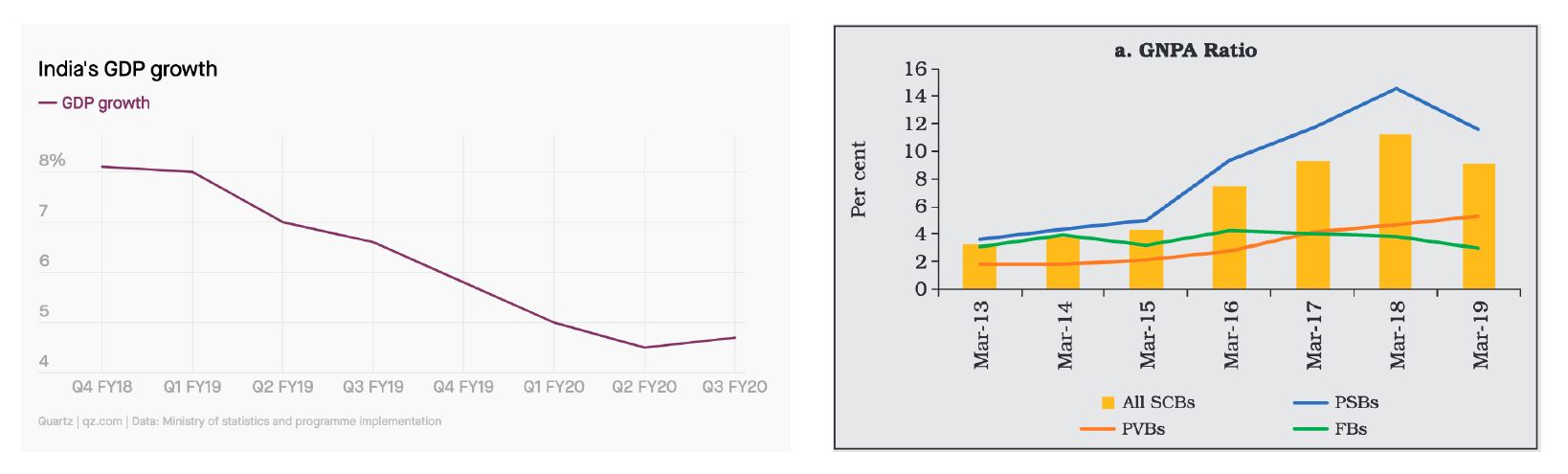
The bigger problems for the banks will definitely be to find demand for credit from the corporations to grow their loans. Because In a slowing economy, there is typically low credit demand. And bank lending less is a clear bad news to the economy because when credit growth slows to companies, it impacts the progress of projects, cash flows and employment generation. But the problem for the bank is not solved when the credit demand rises because, since the banks have already been hit by a massive provisioning requirement for bad loans, they possess insufficient capital to fund the loans once credit demand picks up.
The above problems indicate the liquidity crisis that the banking sector currently faces and show the pressing need for fresh capital infusion into the banks. But the budget for the year 2020 conveyed a different stance taken by the government to address these problems. The government wants banks to accelerate the recovery of bad loans and raise funds from the capital market. The budget focused mainly on governance reforms in PSU banks and tax relaxations (for soon to be merged public sector banks) and did not include separate capital to be injected into the banks. Among the proposed reforms in the budget, an amendment to ‘The deposit Insurance and Credit Guarantee Corporation Act’ was made, which raised the maximum insured amount for bank deposits from 1 Lakh to 5 Lakh rupees, but this came at the cost of the banks paying increased premiums, further adding stress to the existing liquidity crunch.
The absence of capital provision for economic stimulus by the government meant that it is now upto the Reserve Bank of India to support growth through interest rate cuts and capital injection into the banking system. But by the time the RBI had released the Monetary Policy report the entire world had entered a period of a great humanitarian crisis that triggered a deep negative impact to the global economy.
COVID-19 has brought about a global humanitarian and economic crisis, much worse at a time when the economy is moving towards recovery. Since the disease was spreading rapidly, India acted quickly and implemented a Nationwide lockdown. Though the lockdown was aimed at arresting the spread of the disease, it came at the cost of putting the entire economy at a higher risk of slowdown. The impact of the pandemic can be felt through the statements in the Monetary policy report that read
“Prior to the outbreak of COVID-19, the outlook for growth for 2020-21 was looking up. The COVID-19 pandemic has drastically altered this outlook. The global economy is expected to slump into recession in 2020, as post-COVID projections indicate.”
A report by Mckinsey & Company estimating the probable economic outcomes using models stated that if the Lockdown continued until mid-May with moderate relaxations after April, the economy could contract by around 20% in the first quarter of fiscal year 2021, with –2% to –3% growth for fiscal year 2021, and increase the GNPL ratio by 7%. Along with an increase in unemployment, business failures, and financial-system risk. There is also a concern for solvency risk within the Indian financial system, as almost a quarter of the MSME and small- and medium-size-enterprise (SME) loans could slip into default.
Revised GDP projections after the onset of the pandemic 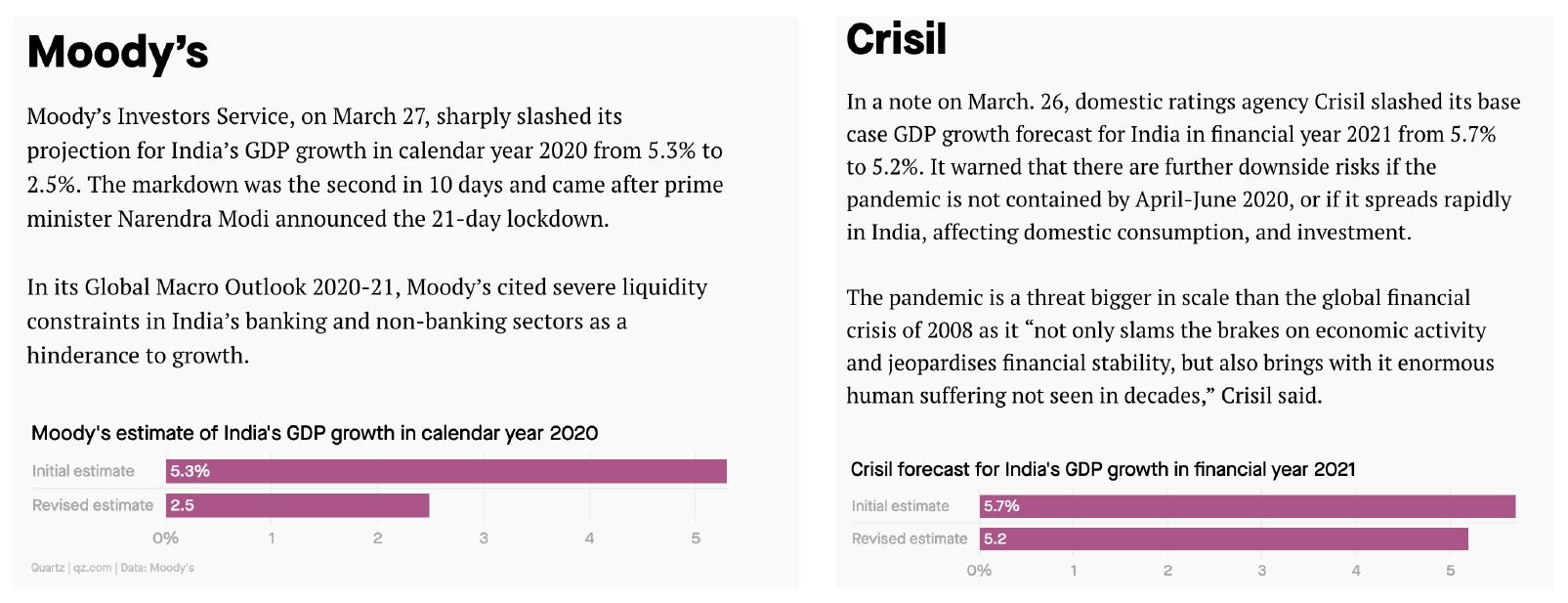
The post lockdown period without a doubt is going to be a critical period not just for the banking sector but for the entire Indian economy as well. Reviving the drivers of consumption and investment while being alert for spillovers from global financial markets will remain a critical challenge. The ability to overcome these challenges, depends on the set of fiscal, monetary, and structural measures employed by the Indian government and the Reserve bank of India. A package of the order of around 5% of the GDP may prove to be vital for withstanding possible declines in aggregate demand and also for protecting the financial system from solvency and liquidity risks. Further, support for large corporations through allowance for debt restructuring and relaxations in procedural requirements for raising capital will contribute significantly towards the health of the economy. In conclusion, devising a credible bail out package and implementing the structural reforms necessary for increasing investment and productivity can influence the pace of recovery and help avoid severe damage to the banking sector, the financial sector and also the entire Indian economy.
*The GNPA as measured on March 2019
References:
- RBI Monetary policy report
- Financial Stability Report
- Report on trend and progress of banking in India 2018-2019
- Deposit Insurance FAQ’s
- Financial system stable despite weakening economic growth; reviving consumption, investment a major challenge: RBI
- In 2020, muted credit growth, not bad loans, will be banks’ main concern; a lot will depend on early economic rebound
- Budget 2020: Banking sector is feeling the heat of economic slowdown
- Covid-19 ripple effect: More taxes, less income
- India may escape a recession, but coronavirus will slow down growth further
- Getting ahead of coronavirus: Saving lives and livelihoods in India
- Public sector banks’ gross NPA ratios may rise to 13.2% by Sept 2020: RBI